KONG
Kong anchor swivels and fixed anchor connectors are machined in AISI 316 stainless at Monte Marenzo in Lecco, covering calibrated chain from 6 to 14mm with published breaking loads between 850 and 5000 kgf. Choosing a Kong anchor swivel turns on chain calibration, bow roller geometry and the direction the load actually arrives from, not on rated strength alone. EN ISO 12401 safety tethers, stainless snap hooks and aluminium carabiners complete the range. Read more below...
|
|
|
|
|
|
|
|
|
|
|
|
|
|
|
|
|
|
|
|
|
|
|
|
|
Kong anchor swivels and fixed anchor connectors
Kong builds two families in AISI 316 stainless: the fixed anchor connector joins chain to anchor shank without rotation. The Kong anchor swivel, catalogued as the swivel anchor connector, adds a rotating joint so the rode can shed turns as the boat swings. Both are shaped around the bow roller: the profile lets the anchor pull up and self-orient rather than jamming across it, which is the argument for a purpose-made connector over a shackle-and-swivel stack. The twisted-body Moorena sits above both on breaking load and suits chain at the top of the range.
Kong anchor swivel sizing
Size the connector to the chain calibration, not to the anchor or the boat. An oversized Kong anchor swivel fouls the gypsy and the bow roller; an undersized one becomes the weak link in the rode.
| Chain | Fixed connector | Swivel connector | Moorena |
|---|---|---|---|
| 6–8mm | 850 kgf | 850 kgf | 2500 kgf |
| 8–12mm | 2000 kgf | 2000 kgf | 5000 kgf |
| 12–14mm | 3000 kgf | 3000 kgf | — |
Figures are Kong's published breaking loads, not working loads.
Do you need an anchor swivel?
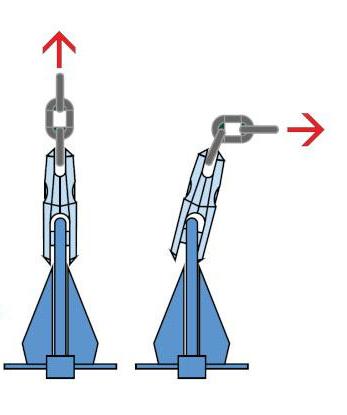
Contested among cruisers, and the answer depends on how the swivel is mounted. Any anchor swivel is rated in tension along its axis. Bolt one straight to the anchor shank and the failure arrives sideways: the anchor lies over on the roller, or the rode veers off at an angle, and load crosses the pin transversely at a fraction of the axial rating. Most reported failures are side-loading, not overload. Two mitigations work: a short length of chain between anchor and swivel so nothing can be levered against the shank, or a connector whose geometry lets the anchor articulate. Kong anchor swivels take the second approach. Where neither suits your bow, a moused shackle and a rode you untwist by hand remains defensible.
Elastic safety tethers
The Kong Elastic Tether range — Single, Double, Evo Single, Evo Double — is certified to EN ISO 12401, the small craft standard for deck safety harnesses and safety lines. The Evo Double carries two arms, roughly 50–75cm and 100–175cm. Use the short arm at the mast and in the cockpit: a tether long enough to let you over the lifelines will hold you alongside in the water, worse than a fall on deck. Each carries a stitched overload indicator, and once it has shown the tether is retired.
Stainless snap hooks and aluminium carabiners
These are not interchangeable. The AISI 316 snap hooks, from 50mm asymmetric to the 160mm buoy hook, are corrosion-resistant connectors for permanent exposure. The Kong aluminium carabiners — ARGON, HMS Twist Lock, HMS Auto Block, Trapper — are light, PPE-certified connectors for handling and life-safety work. Aluminium corrodes galvanically against stainless in salt water, and stainless snap hooks are not life-safety rated.
RIB lifting and towing
The Octopus is a three-point lifting sling with aluminium rigging plate, 227kg safe working load, for craning a RIB or tender. The Tora is a towing bridle with stainless ring and float, and Kong states it is not safe for lifting.
About Kong Italy
Kong S.p.A. was founded in 1830 by Giuseppe Bonaiti and traded as Bonaiti until 1977. It manufactures at Monte Marenzo in Lecco, is ISO 9001 certified, and produces PPE under Regulation (EU) 2016/425. It is one of the established European connector manufacturers, and unrelated to the American pet toy brand.
Kong Italy FAQ block
What size Kong anchor swivel do I need for my chain?
Size to the chain calibration, not to the anchor or the boat. Kong anchor swivels are specified by chain range — 6–8mm, 8–12mm and 12–14mm — with published breaking loads of 850, 2000 and 3000 kgf respectively, and the Moorena rated at 2500 and 5000 kgf. Going oversized is not a safety margin: a connector too large for the calibration will snag in the gypsy or jam on the bow roller, which introduces a worse failure mode than the one you were avoiding.
Do I need a swivel on my anchor?
Not necessarily. A swivel lets the chain shed turns as the boat swings and helps the anchor present correctly to the bow roller on retrieval. Against that, it adds a joint with a directional strength characteristic to the most highly loaded part of the ground tackle. Many experienced cruisers fit one; many deliberately do not, and untwist the rode by hand instead. The decision should turn on your bow roller geometry and how the swivel will be mounted, not on the fitting being inherently good or bad.
Why do anchor swivels fail?
Almost always through transverse loading rather than overload. A swivel is rated in tension along its axis. Bolted directly to the anchor shank, it gets levered sideways whenever the anchor lies over on the roller or the rode veers off at an angle, and its strength in that direction is a small fraction of the rated figure. The two fixes are a short length of chain between anchor and swivel so the swivel cannot be levered, or a connector designed to let the anchor articulate.
How do you install a Kong anchor swivel?
Chain end first, then anchor end, checking that the connector sits in line with the chain's own plane rather than cocked across it. Do not shackle a swivel straight to the anchor shank unless the connector is designed for it — insert a short length of chain, typically two or three links, so the swivel can articulate and cannot be side-loaded. Check that the assembly passes over the bow roller and through the gypsy before relying on it, with the windlass under no load.
What is the difference between a fixed anchor connector and a Kong anchor swivel?
The fixed connector is a rigid link between chain and anchor shank: fewer moving parts, nothing to seize, and no ability to shed turns. The swivel version adds a rotating joint so the rode untwists as the boat lies to wind and tide. Both share the same profile for passing over a bow roller. Choose the fixed connector if you untwist the rode by hand and want the simplest possible link; choose the swivel if your mooring habitually winds turns into the chain.
Is a breaking load the same as a working load?
No. Breaking load is the point of failure in a controlled tensile test. Working load is what the fitting is intended to carry in service, and it is a fraction of the breaking load. Anchoring loads in normal conditions are well below either figure; what matters is the shock loading of a snubbed chain in a swell or a gust, which is why a nylon snubber belongs in the system. Never specify ground tackle by comparing breaking loads alone.
What is a sailing tether?
A tether is the line connecting a deck safety harness or harness-equipped lifejacket to a jackstay or a hard point, so that a fall on deck does not become a fall over the side. It is not a fall-arrest device in the climbing sense — the intent is to stop you leaving the boat. Tethers for small craft are covered by EN ISO 12401, and most carry two arms of different lengths plus a quick-release at the harness end.
How long should a sailing tether be?
Short enough that you cannot reach the water. A tether that lets you over the lifelines will hold you alongside a moving hull, which is a significantly worse position than remaining on deck — recovery from there is difficult and the drag is severe. The two-arm arrangement exists for this reason: the short arm keeps you close when working at the mast or in the cockpit, and the long arm is for moving along a jackstay, where you accept more travel briefly.
When should a safety tether be retired?
Immediately if the overload indicator has shown, which means the tether has taken a shock load and has done its job once. Otherwise, retire it on the manufacturer's stated service life, or earlier on inspection: UV degradation of the webbing, chafe at the stitching, a hook that no longer closes and locks cleanly under its own spring, or corrosion in the hook mechanism. Webbing that has faded noticeably has had significant UV exposure. Date-mark tethers when you buy them.
What does HMS mean on a carabiner?
HMS stands for Halbmastwurfsicherung, the German term for a munter or Italian hitch belay. An HMS carabiner is pear-shaped, with a wide radius at the top so a hitch can roll freely across it and a large gate opening. On a boat the shape is useful anywhere a rope has to run through the connector rather than sit statically in it. A D-shape or asymmetric carabiner puts load closer to the spine and is stronger for its weight, but has less room at the top.
What is the difference between a snap hook and a carabiner?
A snap hook is a single-action connector: a sprung gate opens under thumb pressure and closes on release. A locking carabiner adds a second deliberate action — a screw sleeve, a twist lock or an auto-block — so the gate cannot open accidentally. Anything supporting a person should be a locking connector. Single-action snap hooks are appropriate for mooring lines, fenders, halyard shackles and general utility work on deck.
Can I use an aluminium climbing carabiner on the boat?
For rigging work and going aloft, yes — that is what a certified locking carabiner is for, and it is far lighter than a stainless equivalent. For anything left permanently exposed, no. Aluminium alloy corrodes galvanically where it contacts stainless fittings in salt water, and the surface anodising that protects it wears at the gate and the loading points. Rinse aluminium connectors in fresh water after use and inspect the gate action, or fit stainless where the connector is going to stay outside.
AISI 316 stainless or aluminium — which should I choose?
316 stainless for permanent exposure and for anything sharing a fitting with other stainless hardware: mooring hooks, buoy hooks, snap hooks on mooring strops. Aluminium alloy where weight matters and the connector is carried, handled and rinsed: harness connectors, tether hooks, connectors on a bosun's chair. The deciding factors are galvanic compatibility and whether the connector is life-safety rated, not simply strength — the aluminium connectors here are PPE-certified and the stainless snap hooks are not.
What do the markings on a Kong connector mean?
A PPE-certified connector carries the manufacturer's mark, the applicable standard, the CE mark with the notified body number, the major and minor axis strengths in kN, and a serial or batch number that allows the item to be traced to its production lot and date. That traceability is what lets you establish an in-service date and apply a retirement interval. Record the serial numbers of tethers and life-safety connectors when they enter service.
Can the Kong Tora towing bridle be used to lift a RIB?
No. Kong states explicitly that the Tora is not safe for lifting. It is a towing bridle, designed for horizontal loads with a stainless towing ring and a float to keep the bridle clear of a propeller. Lifting a tender or RIB requires equipment rated for vertical load with a declared safe working load — the Octopus three-point sling with aluminium rigging plate, rated at 227kg, is the item in this range intended for that job.

To install this Web App in your iPhone/iPad press
 and then Add to Home Screen.
